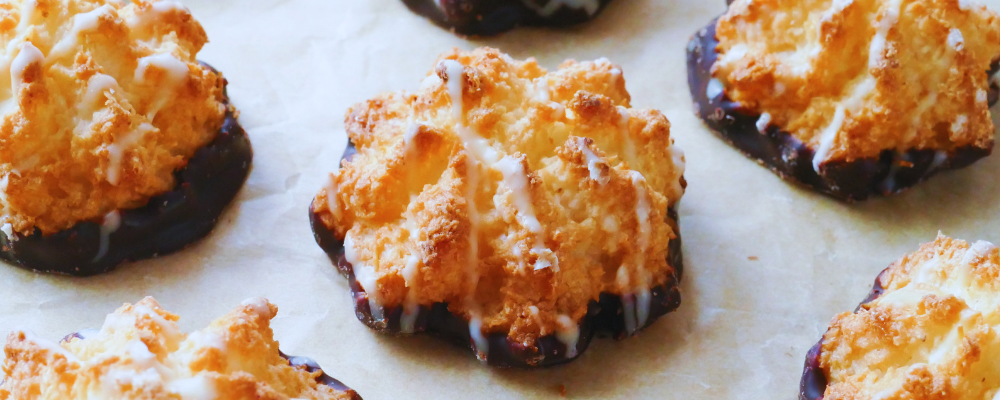
| May 31st — National Macaroon Day |
|
|
|
The macaroon dates back to Renaissance Italy, where it was first made in Venetian monasteries as early as 791. Derived from the word maccherone, meaning “fine paste,” the recipe spread across Europe over centuries, eventually evolving into many regional variations. |
|
| |
|
The classic macaroon is a cookie with a long history — and one that’s frequently confused with its more elegant French counterpart, the macaron. While the two share a similar name and both rely on egg whites for structure, they are distinctly different in appearance, texture, and formulation.
Macaroons are small, round cookies traditionally made with coconut or almond paste, known for their caramelized exterior, crisp texture, and dense, chewy interior. By contrast, the French macaron is a refined meringue-based confection with a smooth shell, ruffled “foot,” and light filling. In many ways, the macaron is considered a French evolution of the original macaroon.
Macaroons are relatively simple in formulation, typically made by whipping egg whites and sugar into a foam, then folding in coconut or almond-based ingredients before depositing and baking. Despite this simplicity, achieving the desired texture depends on proper foam development and careful control of processing conditions.
Egg whites should be at room temperature to promote proper aeration, and all equipment must be free of water and fat, which can destabilize the foam. Acidulants such as cream of tartar may also be added to improve foam stability and mixing tolerance. In coconut-based macaroons, the mixture is often heated during mixing prior to depositing and baking, helping create the characteristic golden-brown, caramelized exterior. See a formula and processing tips on our BAKERpedia article. |
|
|
|
Women in Wholesale Baking |
Watch this engaging on-demand webinar featuring special guest and 2019 Robert A. Fischer awardee, Theresa Cogswell. In this insightful discussion, Theresa and fellow industry professionals explore the topic of women in the wholesale baking industry, sharing perspectives on leadership, career growth, challenges, and opportunities shaping the future of baking.
This webinar offers valuable conversation and inspiration for professionals across all stages of their careers. Speakers: Theresa Cogswell Webinar length: 60 minutes Cost: Free for Members / $99 Non-Members |
| Entry-Level Cookie Cracker Training |
Build a strong foundation in cookie and cracker production with this entry-level training course. Designed for new hires, department transfers, and those needing a refresher, this interactive online program covers the essentials of ingredients, mixing, forming, and baking through engaging lessons, videos, and real-world applications.
With practical, work-ready knowledge and flexible self-paced modules, it’s an excellent resource for onboarding, cross-training, or professional development. Certificate: Upon passing final tests Course length: 6 hours Cost: $250 for Members / $300 Non-Members |
|
|
|
Ask Our Dough Technologist |
|
|
|
Q: How does the timing of flavor addition impact flavor retention in baked products, specifically in dough and batter? |
To get the most even dispersion of flavor additives throughout your dough or batter, the best point to add them would be at the initial mixing stage. However, there are some obstacles to consider: -
The most significant obstacle for any flavoring additive is the baking stage. Many aromatic compounds are highly volatile. When exposed to high oven temperatures, they can evaporate or chemically break down. This often results in a final product where the intended flavor is either muted or clashing with the Maillard reaction and other developing notes.
-
If you are working with yeast-leavened doughs, fermentation adds another layer of complexity. Live cultures don't just proof the dough; they consume sugars and can break down complex flavor molecules. While this can add a desirable "funky" or acidic depth to baked goods, it can inadvertently strip away more delicate flavor additives.
-
The carrier of your flavor should be considered, too. Water-based flavorings, juices, and thin purees can throw off your hydration ratios, potentially turning a structured dough or batter into an unworkable "soup." Gels, concentrates, syrups, and powders provide high-impact flavor with minimal moisture, ensuring your crumb remains exactly as intended.
Alternatively, you could apply flavors post-bake. By utilizing icings, glazes, or injected fillings, you bypass the heat of the oven entirely. This gives you total control over the potency and clarity of the flavor profile.
Have a Dough Question? Submit it Here! |
|
|
|
Webinar: Basics of Chemical Leaveners |
Chemical leavening systems are widely used across bakery products, but their performance depends on proper formulation and understanding of key variables. Join part 2 of our leavening series with E.B. Russell (Lesaffre) for a technical session exploring baking powder components, neutralization value, and practical considerations for working with chemical leaveners.
June 17th | 11:00 AM ET Register Today |
|
|
|
American Society of Baking | 4231 W 96th Street, Indianapolis, IN 46268 Was this email forwarded to you? Subscribe and never miss an update! |
|
|
|