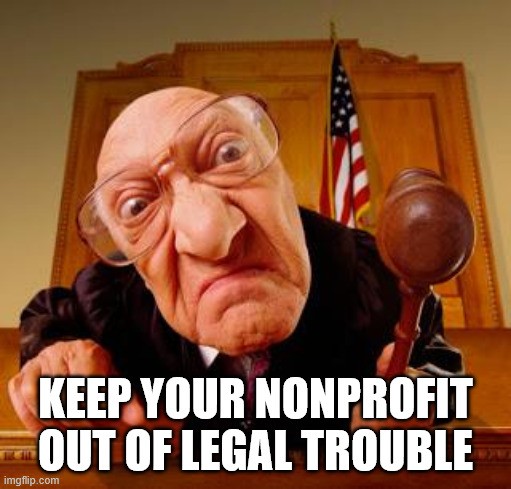
We begin and end this week’s policy update with shameless plugs for the Center’s upcoming legal compliance workshop and nonprofit policy conversations. We also share the latest on possible IRS guidance on the Johnson Amendment and on President Trump’s recommendations for the FY2027 federal budget. |
|
|
Register Today! Nonprofit Legal Compliance Workshop Series Begins Next Friday |
|
|
|
These weekly policy updates provide information on policy issues that could become laws in the future. Of course, nonprofit staff and board members need to be aware of a wide range of existing laws and regulations that affect their organizations’ operations. To help you better understand these laws, the Center is offering a two-part workshop series on legal compliance for nonprofits. The online workshops will be held on April 17 and April 24 from 10:00-11:30 a.m.
|
|
|
The first part on April 17 will cover nonprofit corporate governance, charitable solicitation, fundraising laws, and employment laws. The second part on April 24 will cover federal and state tax compliance issues for 501(c)(3) nonprofits as well as laws and regulations related to federal and state grants and contracts. The Center plans to offer three hours of CLE credit for attorneys who attend the live online workshops (pending approval). Register today.
Along with the legal compliance workshop series, the Center also plans to publish its updated and expanded legal compliance checklist this month. |
|
|
IRS Plans to Issue Guidance on Political Endorsements by Houses of Worship
|
|
|
Last Tuesday, a federal court in Texas dismissed a case in which the Internal Revenue Service and two churches in Texas sought approval of a consent judgment that would have allowed the churches to make political endorsements to members of their congregations. The court ruled that it did not have jurisdiction to decide the case, so it did not rule on the merits of the requested consent judgment. Like other 501(c)(3) tax-exempt organizations, churches may not “participate in, or intervene in (including the publishing or distributing of statements), any political campaign on behalf of (or in opposition to) any candidate for public office.” Essentially, the IRS was seeking a court ruling that this nonpartisanship requirement (sometimes known as the Johnson Amendment) has a narrow exemption for communications from churches and other houses of worship to their congregations “through [their] customary channels of communication on matters of faith in connection with religious services.” As the Center has explained, by undermining the Johnson Amendment, the consent judgment would have set a precedent that could have troubling consequences for the charitable nonprofit sector.
Last Friday, the IRS announced that it is planning to issue guidance to “provide clear, administrable standards for houses of worship, including how the law applies to certain communications made within the context of religious services.” It is likely that this guidance will be similar to the proposed consent judgment. It is unclear whether the IRS is planning to issue this guidance through regulations, a revenue ruling, or informal guidance. Any regulation limiting the applicability of the Johnson Amendment would almost certainly be challenged in federal court since the IRS almost certainly does not have the authority to issue these regulations based on the U.S. Supreme Court’s 2022 Loper Bright v. Raimondi decision, which limits rulemaking authority of federal agencies. In the meantime, the Johnson Amendment remains fully in place without any limitations.
|
|
|
President Trump Releases FY2027 Federal Budget Proposal |
|
|
Last Friday, President Trump released his proposal for the FY2027 federal budget. Overall, President Trump proposes cutting non-defense discretionary spending (i.e., spending on programs that provide funding for or complement the work of many charitable nonprofits) by about 10% from current levels. This would represent a $73 billion reduction in federal spending. Many of President Trump’s proposed budget cuts could affect federal grants for nonprofits, including his proposal to cut “woke programs” and to end the “Green New Scam.”
While the budget proposal highlights the President’s policy and funding priorities, it is extremely unlikely that many of the proposals (particularly the most extreme ones) will ultimately be a part of the federal budget. Congress will work in a bipartisan manner over the next 5½ months – and quite likely much longer – to agree on the details of the federal budget for FY2027, which begins on October 1. |
|
|
New U.S. House Bill Would Prohibit Nonprofits from Receiving Contributions from Donors from Certain Countries |
|
|
A bill (H.R. 8166) filed in the U.S. House of Representatives last week would amend the Internal Revenue Code to revoke the tax-exempt status of any 501(c)(3) or 501(c)(4) nonprofit that receives contributions from donors from “foreign adversary nations”, including China, Cuba, Iran, North Korea, and Russia. While this proposal could cause administrative challenges for nonprofits in tracking the nationality of all of their donors, it is unlikely that this bill will become law.
|
|
|
Join a Nonprofit Policy Conversations This Spring |
|
|
- Monday, April 27 from 10 a.m.-12 noon at Foundation For The Carolinas in Charlotte in collaboration with Foundation For The Carolinas (Register Now);
-
Monday, May 11 from 10 a.m.-12 noon at the CCF Community Room in Fayetteville in collaboration with Cumberland Community Foundation (Register Now); and
- Monday, June 15 from 10 a.m.-12 noon at Centennial Station Arts Center in High Point in collaboration with Guilford Nonprofit Consortium, HandsOn NWNC, and One Sector, One Voice Triad (Register Now).
|
|
|
At each policy conversation, the Center will provide a public policy briefing that includes the latest information about recent federal executive actions that could affect nonprofits and a preview of what nonprofits can expect during the 2026 short session of the NC General Assembly. We will also have a discussion for participants to share their insights about important state and federal policy issues for 2026. |
|
|
|