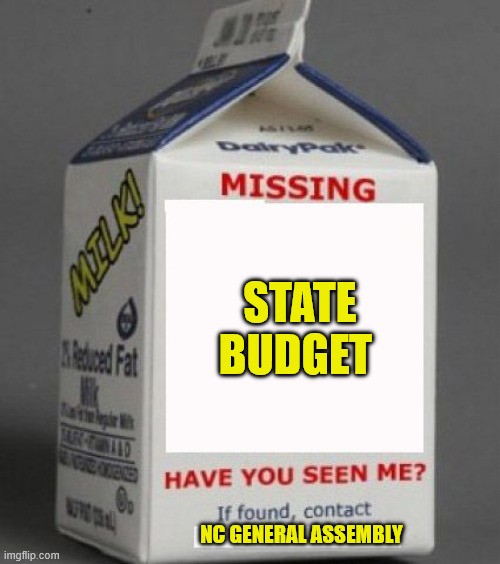
The NC General Assembly 2026 short session starts next month, and this week’s policy update begins with a preview of four significant policy issues that could affect nonprofits. We share news of a letter from several state attorneys general – including NC’s Jeff Jackson – to GoFundMe seeking to protect charitable nonprofits from harm from GoFundMe’s unauthorized creation of fundraising pages for more than a million nonprofits. And we provide updates on recent federal developments affecting nonprofits with federal grants, nonprofits that received American Rescue Plan Act funding, and the Combined Federal Campaign.
|
|
|
Several Legislative Priorities During 2026 Short Session Could Affect Nonprofits |
|
|
|
The NC General Assembly is scheduled to have its monthly mini-session next week. Neither the NC Senate nor the NC House of Representatives is planning to have voting sessions during next week’s mini-session. Legislators will likely not vote on legislation until the 2026 short session begins on April 21. During the short session, legislators can vote on a state budget, bills that passed either the House or Senate in 2025, legislation recommended by a study committee, and election law changes.
Several legislative priorities for the short session are likely to have significant impacts on nonprofits, including: |
|
|
-
Passing a state budget. North Carolina is the only state in the country that has not passed a state budget for FY2025-27 after the House and Senate ended their 2025 session without agreeing on a compromise budget. While North Carolina law ensures that recurring state funding continues even if legislators cannot agree on a budget (meaning there is no threat of a state government shutdown), the absence of a budget prevents lawmakers from appropriating money for new needs in various parts of the state, making new grants to nonprofits, and increasing pay for state employees and public school teachers.
-
Medicaid funding. Last year, the NC General Assembly failed to fully fund Medicaid for FY2025-26, leaving a funding gap of about $319 million. Because of this, the NC Department of Health and Human Services (DHHS) implemented Medicaid rate cuts effective October 1, 2025. DHHS retroactively rescinded these rate cuts in December 2025 after a variety of Medicaid providers sued DHHS. Both the NC Senate and the NC House of Representatives have unanimously approved bills to fully fund Medicaid, but the chambers have been unable to agree on whether to include other provisions in the Medicaid funding legislation. Without agreement on full Medicaid funding early in the short session, DHHS could soon be forced to make further cuts to Medicaid.
-
Medicaid changes to conform with OBBBA. The One Big Beautiful Bill Act (OBBBA) that Congress passed last summer makes several changes to Medicaid that will affect North Carolina’s Medicaid program. Two of those changes – requiring states to have work requirements for Medicaid participants and requiring states to verify Medicaid participants' eligibility every six months instead of every year – will take effect on January 1, 2027. Legislators will likely work with DHHS to amend the state’s Medicaid laws to account for these new requirements, and legislators will need to appropriate funding for the additional administrative costs of adding work requirements and more frequent redeterminations to the Medicaid system.
-
Property tax reforms. A House committee has been meeting over the past three months to explore legislation "to study options to reduce the property tax burden on taxpayers in North Carolina.” Changes to state property tax laws could affect charitable nonprofits in a variety of ways. Legislative proposals could include limiting or eliminating property tax exemption for some 501(c)(3) nonprofits. And proposals to limit local governments’ ability to increase property tax collections could help keep lease prices down for nonprofits that rent their property but also could force many counties and municipalities to cut back on expenses, potentially meaning fewer local government grants for nonprofits. The Center has written a blog post to help your organization better understand what is at stake for nonprofits in property tax reform.
|
|
|
NC Attorney General Joins Letter Demanding GoFundMe Take Actions to Address its Unauthorized Creation of Nonprofit Pages
|
Last fall, the crowdfunding platform GoFundMe created donation pages on its website for 1.4 million nonprofit organizations without their knowledge or consent. Nonprofits, including many organizations in North Carolina, expressed concerns that this action by GoFundMe violated the trust of many nonprofits, created confusion among donors, harmed nonprofits by establishing search engine optimization for GoFundMe’s nonprofit pages at the expense of nonprofits’ own websites, and threatened to give GoFundMe a large portion of donations to nonprofits through GoFundMe fees and “tips” (the default “tip” for GoFundMe was set at 16.5% of the donated amount). The Center also believes that GoFundMe likely infringed on the trademarks of many nonprofits and may have violated the state’s charitable solicitation licensing law by soliciting funds on behalf of North Carolina nonprofits without their signed written consent.
After significant advocacy by the National Council of Nonprofits, the Center, and many other nonprofits, GoFundMe issued an apology to nonprofits and indicated that it planned to take corrective action.
On Tuesday, the attorneys general from 23 states, including North Carolina, sent a letter demanding that GoFundMe take further action to demonstrate that it has removed all unauthorized donations pages from its website and to explain how its modified practices “ensure charities’ own fundraising campaigns or websites are not disadvantaged.” The letter highlights some of the Center’s concerns about GoFundMe’s potential violation of the NC charitable licensing statute.
The Center is appreciative of NC Attorney General Jeff Jackson for helping protect charitable nonprofits in North Carolina by signing on to this demand letter on behalf of the State of North Carolina. |
|
| GSA Accepting Public Comments on Proposed Anti-DEI Certification Requirements for Nonprofits with Federal Grants |
On January 28, the U.S. General Services Administration (GSA) posted a notice on the Federal Register indicating that it intends to amend the certification requirements in the System for Award Management (SAM) registration system for nonprofits with federal grants to “align with updated executive branch guidance” on discrimination. The posting specifically references the June 2025 U.S. Department of Justice (DOJ) memo with guidance on the types of policies and practices that are deemed “unlawful discrimination” for recipients of federal funds, including nonprofits with federal grants or contracts. Among other things, the memo asserts that diversity, equity, and inclusion (DEI) policies and practices are unlawful discrimination and asserts that “unlawful proxy discrimination” is unlawful discrimination. The memo gives several examples of “proxy discrimination” in hiring and promotion decisions and determinations about program recipients for nonprofits receiving federal funding. These examples include the use of criteria like “cultural competence,” “lived experience,” “overcoming obstacles” narratives, and targeting programs and services to specific geographic areas based on their racial or ethnic composition. The memo implies that federal agencies could freeze or discontinue grant funding for nonprofits that are engaged in practices or policies that DOJ deems discriminatory, either directly or through proxy criteria.
GSA also has posted on the Federal Register a draft of its proposed certification requirement (click “Download File” on the link to access the draft certification). Because the proposed certification requirement is broad and vague, the Center and other nonprofits are concerned that many nonprofits with federal grants and contracts may not be comfortable signing the certification since it may not be clear whether their policies, procedures, and operations are consistent with the terms of the certification. This concern is heightened by DOJ’s recent increase in investigations and prosecutions of federal contractors for alleged violations of the False Claims Act. Nonprofits that are unwilling or unable to make required certifications on SAM.gov can lose their federal funding.
GSA is accepting public comments on the proposal for amendment SAM certification requirements through March 30. Nonprofits with concerns about the proposed certification requirements may want to consider submitting public comments. Nonprofits also can join on a national sign-on letter to GSO expressing concerns about the proposed certification requirements.
|
|
|
U.S. Treasury Department Requires New Reporting Requirements for ARPA Funding Recipients |
|
|
|
Last month, the U.S. Department of Treasury published a proposal on the Federal Register to require grantees (including states, local governments, and nonprofits) to report retroactively on personal identifiable information for all beneficiaries of American Rescue Plan Act (ARPA) funds administered by the agency. |
|
|
If implemented, the changes would require grantees to report to Treasury personal identifiable information – including addresses, phone numbers, and social security numbers – for staff, board members, and community members. The U.S. Conference of Mayors has a helpful summary of the proposed reporting requirements and the administrative burdens they may create for cities and other recipients of ARPA funds, including nonprofits. Because states and local governments would also be required to adhere to these reporting requirements, nonprofits that received ARPA funds as grants from the state of North Carolina or from their counties or municipalities may also need to provide this personal identifiable information so state agencies and local governments can file their reports with the U.S. Department of Treasury.
|
|
|
OPM Plans to Keep Combined Federal Campaign Portal Open Through at Least Today |
Two weeks ago, the U.S. Office of Personnel Management (OPM) sent a message to the more than 4,400 charitable nonprofits that participate in the Combined Federal Campaign (CFC) indicating that it will end the program in the near future. OPM plans to keep the CFC portal open through at least today so nonprofits participating in the program this year can still upload their materials and resources. The CFC is the country’s largest workplace giving program. Since it was created in the 1960s, the CFC has helped raise nearly $9 billion for nonprofits, including $66 million last year. Through the CFC, donations are dispersed to nonprofits across different regions, including 75 nonprofits based in North Carolina. OPM also attempted to end the CFC in 2025, but ultimately allowed it to continue last year. Nonprofits participating in the CFC this year should strongly consider uploading any materials to the portal today since it is unclear whether OPM will keep the portal open after today.
|
|
|
|