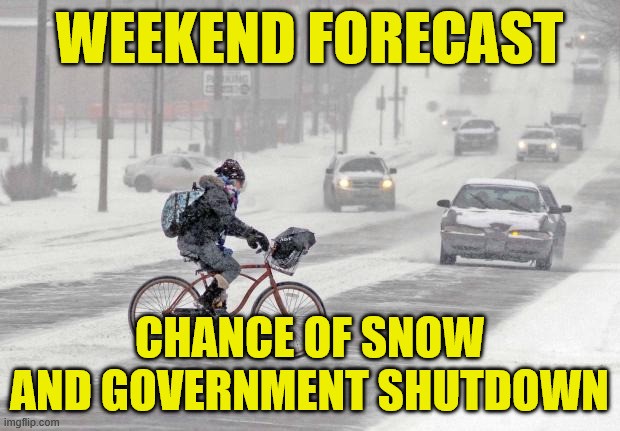
With snow in the forecast (again) for much of North Carolina this weekend, the first item in this week’s policy update explains how problems with ICE could lead to another federal government shutdown. We includes tips for preparing for the upcoming primary election, including reminders about two upcoming webinars for nonprofits. And we share details on three nonprofit-friendly recommendations that the National Taxpayer Advocate sent to Congress this week. |
|
|
Partial Federal Government Shutdown Appears Likely Tomorrow
|
|
|
| A partial shutdown of the federal government is looming tomorrow after the U.S. Senate was unable to pass appropriations legislation yesterday.
Over the past two weeks, the U.S. House of Representatives completed its appropriations process by passing three bills that would fund parts of the federal government through the end of the current fiscal year (September 30): |
|
|
- A bipartisan bill (H.R. 7006) to fund the U.S. Departments of the State and Treasury (including the Internal Revenue Service) for the remainder of the fiscal year.
-
A bipartisan bill (H.R. 7148) that would provide funding for the U.S. Departments of Defense, Education, Health and Human Services, and Housing and Urban Development for the remainder of the fiscal. All of these federal agencies provide a variety of grants to nonprofits and work closely with nonprofit organizations to provide a wide range of services in communities.
- A bill (H.R. 7147) to fund the U.S. DHS for the remainder of the fiscal year. The House approved that bill in a mostly party-line vote, largely due to partisan differences about immigration enforcement.
|
The Senate combined the three bills into one vote. The first two bills, which include significant funding for federal nonprofit grant programs, have broad bipartisan support and could easily meet the 60-vote threshold to pass in the Senate. However, Senate Democrats are unwilling to approve the Homeland Security appropriations bill without significant reforms to immigration enforcement.
Late yesterday, Senate Democrats and President Trump reached an agreement for the Senate to approve a two-week continuing resolution to fund DHS and for the Senate to vote separately on the remaining appropriations bills. However, it was not clear whether the Senate would actually vote on that plan today. If the Senate approves that funding plan, the House would need to vote on it again before it goes to President Trump. Because the House is out of town this week and will not have votes until Monday, it is almost certain that parts of the federal government will be shut down this weekend (at least until the House votes next Monday).
Congress has already approved legislation to fund roughly half of federal agencies through the remainder of the fiscal year. In November, Congress agreed on legislation (which President Trump signed into law) to provide full-year funding for the U.S. Department of Agriculture, military construction, veterans’ services, and congressional staff. Last Friday, President Trump signed into law another bill (H.R. 6938) to provide funding for the remainder of the fiscal year for the U.S. Departments of Commerce, Interior, and Justice, and for the Environmental Protection Agency and the Army Corps of Engineers.
If the partial government shutdown extends beyond this weekend, it could create delays in federal grant payments to some nonprofits. Note that a partial government shutdown will not affect the Supplemental Nutrition Assistance Program (SNAP), since SNAP was funded through the end of the fiscal year as part of the Department of Agriculture appropriations legislation enacted in November. |
|
|
Next Friday is Voter Registration Deadline for Primary Election Day Voting |
|
|
North Carolina residents who plan to vote in person in the primary election on Tuesday, March 3 must be registered to vote at their current address by next Friday, February 6. There are two steps to confirming your voter registration status: |
-
Check your voter registration on the NC State Board of Elections (NCSBE) Voter Search tool to confirm that you are registered at your current address. While you are there, you can check out your sample ballots for the primary election.
-
Make sure that you are not on the NCSBE Registration Repair list. If your name is on this list, you will need to provide your driver’s license, NCDMV ID card, or the last four digits of your Social Security number to election officials in order to receive a regular ballot rather than a provisional ballot when you vote. NCSBE has instructions for how you can do this online (through DMV), in person (at your county board of elections), or by mail (through NCSBE).
|
Anyone who is not registered at their current address by next Friday can register or update their address and vote in person during next month’s early voting period (February 12-28). |
|
|
Join Two Free Webinars on Nonpartisan Voter Registration and Voter Education Work in 2026 |
|
|
|
In-person voting for the 2026 election begins in less than two weeks, with early voting for the primary election opening on Thursday, February 12. While 501(c)(3) nonprofits cannot support or oppose candidates for office or make campaign contributions, your nonprofit can (and should) engage in nonpartisan voter registration and voter education work. To help your nonprofit do this, the Center is offering two free webinars over the next two weeks: |
- A webinar next Tuesday, February 3 from 1-2 p.m. to share the many great resources that You Can Vote provides to make it easy for North Carolina nonprofits to engage in effective nonpartisan voter registration and voter education activities. Register today.
- A webinar on Tuesday, February 10 from 1-2 p.m. to help answer your questions about the ways nonprofits can safely, legally, and effectively engage in the 2026 election. Register today.
|
|
|
National Taxpayer Advocate Recommends Three Nonprofit-Friendly Tax Law Changes
|
|
|
In its annual report to Congress this week, the National Taxpayer Advocate made three nonprofit-friendly recommendations to encourage volunteering and make tax filings easier: |
-
Setting a single mileage deduction rate for all forms of vehicle usage – volunteer, moving/military, and business. Currently, the volunteer mileage rate (the amount your nonprofit’s volunteers can deduct when they drive on behalf of your organization) is fixed at 14 cents per mile while the IRS recently adjusted the business mileage rate (the rate many nonprofits use to reimburse their employees for work-related driving) to 72.5 cents per mile.
- Eliminating the requirement that charitable organizations provide “contemporaneous” acknowledgment of donations to help ensure that taxpayers don’t lose out on tax deductions for their charitable contributions due to technicalities. This change is particularly important in 2026 when almost all taxpayers will be eligible for tax deductions for at least some of their charitable contributions thanks to the new universal charitable deduction.
-
Having Congress provide consistent, automatic tax relief to individuals, businesses, and nonprofits that are affected by federally-declared disasters. Congress often – but not always – provides for tax extensions and special tax treatment, including tax credits for retaining employees, for people and organizations affected by natural disasters. A consistent, automatic approach would provide greater certainty to nonprofits and the people they serve when natural disasters affect their communities.
|
Congress would need to act for any of these recommendations to come to fruition. |
|
|
|