Nonprofit advocacy doesn’t always involve government! This week’s update begins with details of nonprofits’ quick advocacy to help address the fiasco stemming from GoFundMe’s recent decision to create donation pages for 1.4 million nonprofits without their knowledge or consent. We provide information about several developments affecting nonprofits during a busy week of action and inaction at the NC General Assembly. And we share the latest on the federal government shutdown (it’s still going) and the federal lawsuit involving the IRS enforcement of the Johnson Amendment.
|
|
|
GoFundMe Issues Apology for Betraying Trust of Nonprofits Across the Country |
Recently, the crowdfunding platform GoFundMe created donation pages on its website for 1.4 million nonprofit organizations without their knowledge or consent. Nonprofits, including many organizations in North Carolina, expressed concerns that this action by GoFundMe violated the trust of many nonprofits, created confusion among donors, harmed nonprofits by establishing search engine optimization for GoFundMe’s nonprofit pages at the expense of nonprofits’ own websites, and threatened to give GoFundMe a large portion of donations to nonprofits through GoFundMe fees and “tips” (the default “tip” for GoFundMe was set at 16.5% of the donated amount). The Center also believes that GoFundMe likely infringed on the trademarks of many nonprofits and may have violated the state’s charitable solicitation licensing law by soliciting funds on behalf of North Carolina nonprofits without their signed written consent.
After significant advocacy by the National Council of Nonprofits, the Center, and many other nonprofits, GoFundMe issued an apology to nonprofits yesterday. In its apology, GoFundMe says that it will:
|
- Make nonprofit pages opt-in only moving forward.
- Remove nonprofit pages that have not been claimed and verified.
- Make search engine optimization opt-in rather than the default for nonprofit pages.
|
It is unclear how quickly GoFundMe plans to remove nonprofit pages that have not been claimed or verified or how GoFundMe plans to handle nonprofit pages that were claimed by individuals who aren’t actually associated with the nonprofit. In the meantime, nonprofits are encouraged to check the GoFundMe nonprofit pages to see whether one was created for your organization and to ensure that your page (if it exists) wasn’t claimed by someone who is not associatied with your organization. GoFundMe also has posted instructions for how to claim and manage your nonprofit page. If your nonprofit (understandably) doesn’t trust GoFundMe, this resource from Whole Whale has a helpful synopsis of the GoFundMe nonprofit fiasco and steps nonprofits can take to safely remove their pages.
Thank you to the many nonprofits that reached out to the Center with concerns about this situation this week. |
|
|
Medicaid Rate Cuts Continue After NC Senate Opts Not to Vote on Medicaid Funding |
On October 1, the NC Department of Health and Human Services (DHHS) cut rates for Medicaid providers, including many nonprofits. The cuts came after the NC Senate and NC House of Representatives were unable to agree on legislation to fully fund Medicaid for the current fiscal year. Specifically, DHHS: |
-
Implemented a 3% rate reduction for providers of most services to Medicaid recipients;
- Implemented a 10% rate reduction for acute care hospitals, nursing homes, psychiatric residential treatment facilities, and research-based Behavioral Health Therapy/Applied Behavior Analysis services for people with autism, and implemented an 8% rate reduction for intermediate care facilities; and
-
Reduced Medicaid administrative costs, including ending or reducing some contracts, halting some projects, and cutting back on compliance and quality assurance activities.
|
- A bill (H.B. 491) that would provide DHHS greater flexibility to use reserve funds to cover Medicaid expenses; and
-
A bill (S.405) that would provide full funding for Medicaid and would require DHHS to eliminate enough vacant positions to save about $34 million per year.
|
The House passed both bills by unanimous votes, but the Senate did not vote on either of them. It remains possible that DHHS could end the rate reductions if legislators agree on full funding for Medicaid later this year. |
|
|
Federal Government Shutdown (Still) Continues |
|
|
|
Today marks the 24th day of the federal government shutdown as Congress and the White House remain unable to reach an agreement on appropriations legislation for the current federal fiscal year. Last month, the U.S. House of Representatives approved a “clean” continuing resolution (H.R. 5371) that would extend federal funding through November 21. The bill needs 60 votes to pass the Senate.
|
| |
The Senate has rejected the bill 12 times in the past four weeks. This week, Senators also rejected separate bills to pay members of the military and essential federal workers and to pay all federal workers during the shutdown. Most Senate Democrats oppose the temporary spending bill or a partial spending bill for two reasons: |
-
Without congressional action, the enhanced premium tax credits on their Affordable Care Act (ACA) Marketplace health plans are scheduled to end after this year. Translation: The cost of ACA Marketplace health coverage will increase significantly for many North Carolinians in 2026, including for many people who are clients of nonprofits and employees of nonprofits that do not offer employer-provided health coverage. Some congressional leaders have indicated that Congress could consider extending the enhanced tax credits in December. Democrats have expressed concerns that this will be too late since open enrollment for ACA Marketplace plans opens on November 1.
- President Trump has twice this year used rescissions to cancel billions of dollars of congressionally-approved funding. Democrats want future appropriations legislation to include assurances that President Trump will not have the authority to rescind other funding approved by Congress.
|
If the shutdown continues into November, it is possible that funding could run out for the Supplemental Nutrition Assistance Program (SNAP) and the Special Supplemental Nutrition Program for Women, Infants and Children (WIC) programs.
A prolonged government shutdown could lead to lapses in service for many people served by nonprofits and for delayed or cancelled payments to nonprofits that provide services through federal grants and contracts. Let us know if your nonprofit has been affected by the federal government shutdown and/or if you anticipate that a prolonged shutdown could affect your nonprofit or the people you serve.
|
|
|
IRS Cancels Oral Arguments in Case Involving Political Endorsements by Churches |
|
|
|
On Wednesday, a federal court in Texas canceled oral arguments in a case in which the Internal Revenue Service has requested a consent judgment that would allow two churches to make political endorsements to members of their congregations. Like other 501(c)(3) tax-exempt organizations, churches may not “participate in, or intervene in (including the publishing or distributing of statements), any political campaign on behalf of (or in opposition to) any candidate for public office.”
|
|
|
Essentially, the IRS is interpreting the nonpartisanship requirement (sometimes known as the Johnson Amendment) as having a narrow exemption for communications from churches and other houses of worship to their congregations “through [their] customary channels of communication on matters of faith in connection with religious services.”
The oral arguments had been scheduled to take place on November 7 in the District of Columbia. Last week, the IRS asked the court to indefinitely delay the oral arguments due to the federal government shutdown. The court (somewhat mockingly) rejected the IRS’s request, but it wound up canceling the oral arguments anyway, without giving any reason for its decision. It is unclear if or when oral arguments may be rescheduled.
If the court were to issue the consent judgment, it would not be appealable and would limit the exception to the Johnson Amendment to the two churches that are parties to the case. However, Americans United for Separation of Church and State (AU), a left-leaning advocacy group, filed a motion to intervene in the case in July, effectively arguing that it has a legal interest in the case and that none of the parties to the case adequately represent its interest. If the court eventually hears oral arguments, it could consider whether to allow AU to intervene in the case. If the court ultimately grants the motion to intervene, AU would have the right to appeal the consent judgment, which could ultimately lead to a broader appellate court ruling (perhaps ultimately by the U.S. Supreme Court) on whether the nonpartisanship provision in Section 501(c)(3) of the Internal Revenue Code is allowable under the First Amendment. (Spoiler alert: There is a strong chance that an appellate court would strike down the nonpartisanship provision in its entirety, potentially affecting all 501(c)(3) nonprofits.)
As the Center explains in a blog post with more analysis of the case, the IRS’s action could have implications for all 501(c)(3) nonprofits. Several nonprofits have asked the Center what, if anything, they should do in light of the IRS’s recent action. Our main advice is that charitable nonprofits should continue to refrain from engaging in any type of partisan political engagement.
|
|
|
State Legislators Remain at Impasse on State Budget |
Nearly four months into the state’s fiscal year, the NC Senate and the NC House of Representatives remain at an impasse on details of the state budget for FY2025-27. Legislators did not vote on a comprehensive state budget during this week’s mini-session. While state law prevents a government shutdown when legislators and the Governor are unable to pass a budget, the lack of a budget has a variety of consequences for state government operations, for nonprofits, and for North Carolinians.
During this week’s mini-session, legislators approved a mini-budget (S.449) which provides support for Hurricane Helene relief as well as funding for a few other state programs, none of which directly affect nonprofits. On Wednesday, the NC House of Representatives approved another mini-budget bill (S.599) that would provide pay raises for public school teachers, state employees, and local law enforcement officers. The Senate did not vote on the pay raise mini-budget during its session on Tuesday, but legislators could take it up in a future mini-session.
The House did not vote on a previously-approved Senate mini-budget (H.B. 389) that would: |
-
Provide $30 million in one-time funding to extend the Healthy Opportunities Pilot (HOP) program that has provided support for many nonprofits in eastern and western North Carolina working on social determinants of health;
- Provide $35 million in one-time funding to re-establish the School Safety Grant Program, some of which would go to grants to nonprofits; and
-
Require transparency about which legislators requested specific appropriations and provisions in the state budget.
|
Legislators could vote on a state budget during their next mini-session, which takes place November 17-20. However, legislative leaders indicated this week that it is unlikely that lawmakers will have any more voting sessions until sometime in 2026. |
|
|
NC General Assembly Approves New Congressional Districts for Eastern NC |
|
|
|
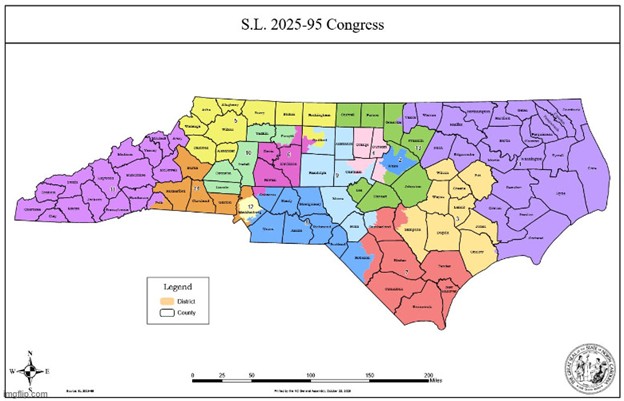
This week, the NC Senate and NC House of Representatives approved legislation (S.249) to create new congressional districts in eastern North Carolina. Specifically, legislative leaders redrew North Carolina’s 1st and 3rd congressional districts by moving Greene, Lenoir, Wayne, and Wilson counties from the 1st District to the 3rd District and by moving Beaufort, Carteret, Craven, Dare, Hyde, and Pamlico counties from the 3rd District to the 1st District.
|
|
|
Under the new congressional map, North Carolina will likely be represented by 11 Republicans and three Democrats in the U.S. House of Representatives beginning in 2027. Legislators made clear that the redistricting change was done for purely partisan reasons (which is legal) rather than for race-based reasons (which, at least for now, would be illegal under Section 2 of the federal Voting Rights Act of 1965).
|
|
|
NC House Committee Investigates Defunding of Legal Services Nonprofits |
On Wednesday, the NC House Oversight and Reform Committee held a hearing to investigate the NC State Bar’s IOLTA grant program, which provides grant funding to a variety of legal services programs. Earlier this year, the NC General Assembly passed legislation (S.429) to prevent the NC State Bar from making grants through this program for the FY2025-26 fiscal year, essentially defunding many legal services nonprofits for this year.
During this week’s committee hearing, legislators stressed that many legal services nonprofits provide important support for North Carolinians in need, but expressed concerns that some grant recipients are engaged in diversity, equity, and inclusion (DEI) activities, in partisan political engagement (which is impermissible for 501(c)(3) nonprofits), and in controversial advocacy activities. NC State Bar staff noted that grants from the NC IOLTA cannot be used for lobbying or political activities but that there aren’t prohibitions on other activities of grantees. It is possible that legislators could consider adding rules to the NC IOLTA grant program prohibiting grantees from engaging in any lobbying or advocacy activities.
|
|
|
NC House Approves Bill to Exclude Planned Parenthood from Medicaid Payments
|
On Wednesday, the NC House of Representatives approved a bill (S.378) that would make Planned Parenthood Federation of America and other associated nonprofits ineligible for Medicaid payments in North Carolina. The Senate bill was facilitated by two recent federal actions: |
-
In June, the U.S. Supreme Court ruled in the Medina v. Planned Parenthood South Atlantic decision that the State of South Carolina could prevent a Planned Parenthood organization from participating in the state’s Medicaid program. South Carolina has a state law that prevents state funds from being used to pay for abortions. While the organization in that case provides abortion services, it also provides a variety of other women’s health services that would have been eligible for Medicaid, but the state decided not to allow the organization to receive Medicaid funding for any of its health services.
- A provision (Section 71113) in the One Big Beautiful Bill Act prevents Planned Parenthood from receiving Medicaid payments for a one-year period beginning on the enactment of the law on July 4, 2025.
|
The NC Senate approved a bill (H.B. 192) last month that included the same exclusion of Planned Parenthood from Medicaid. The Senate’s version also included a separate provision (which apparently lacks support in the House) that would add new requirements for hospitals to provide significantly more information to patients about the cost of specific services. It is unclear whether legislators will ultimately agree on legislation to exclude Planned Parenthood from Medicaid.
|
|
|
Don’t Miss 2025 Conference for NC’s Nonprofits |
Join nonprofit peers from across the state – in person – at the 2025 Conference for NC’s Nonprofits, November 19-20 in RTP. The Center recently announced the session agenda, featuring expert speakers and topics on everything from growing leadership, fundraising in any climate, nonprofit public policy trends, and building powerful partnerships to fostering cohesive workplaces and uncovering fresh revenue. Check out the full line up and register now –Early bird registration rates end on October 30!
|
|
|
|